
In This Article
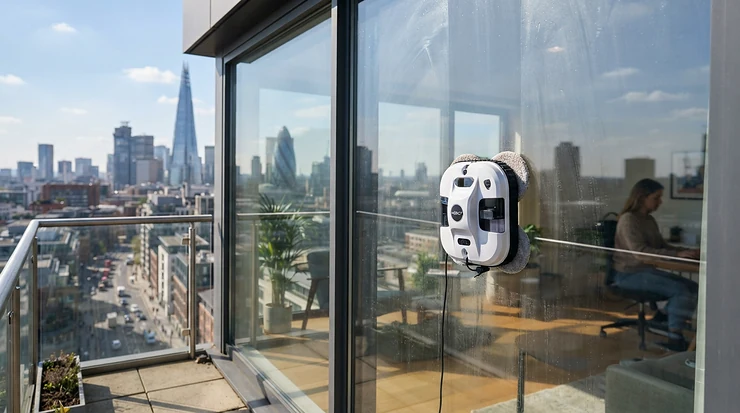
A cordless window cleaning robot for high-rise apartment use is a self-propelled glass cleaner that clings to a pane with vacuum suction, runs on a built-in battery instead of a trailing mains cable, and is tethered by an anti-fall rope. It wipes the glass along a planned route while you stay safely indoors.
Picture the 22nd floor. The view is spectacular, the balcony glass is streaked with city grit, and the only “cleaning tool” you own is a squeegee you’d have to lean out a railing to use. That’s the moment this category earns its keep.
First, a reality check on the word “cordless.” It’s the most slippery term in this market. Most window bots stay plugged in, and one reviewer’s explainer on robot window cleaners points out that mains power is the usual way to keep the weight down. So a model with a genuine built-in battery is the exception. Many “battery-backed” robots only carry a short emergency pack that holds them on the glass if the power cuts out. That’s a safety feature, not freedom from the cable.
This guide separates the two. Everything below is built from manufacturer documentation, spec sheets and published reviews, not from claimed personal testing. Where verified reviews were thin, I’ve said so and compensated with deeper spec reasoning.
Expect real numbers, honest trade-offs and a safety-first mindset, because a robot on a high floor is a falling-object risk, not just a convenience.
Quick Comparison: 7 Robots at a Glance
| Model | Power Setup | Listed Suction | Anti-Fall Backup | Best For |
|---|---|---|---|---|
| Ecovacs Winbot W2 Pro Omni | Station battery (4,500 mAh, ~110 min) | Check listing | Composite rope + power cord | Ecovacs Winbot W2 Pro Omni: outlet-free balconies |
| Ecovacs Winbot W2S Omni | Station battery (4,500 mAh) | 8,000 Pa | ~30 min hold on low battery + rope | Ecovacs Winbot W2S Omni: strongest adhesion margin |
| Ecovacs Winbot W2 Omni | Station battery (4,500 mAh, ~110 min) | 5,500 Pa | Weighted station + rope | Ecovacs Winbot W2 Omni: value-minded cordless buyers |
| Hobot S7 Pro | Corded (~6.4 m total cable) | 4,800 Pa | Verify on listing | Hobot S7 Pro: large, lightly soiled glass |
| Hobot 2S | Corded | Check listing | 20 min UPS + rope | Hobot 2S: ultrasonic-spray fans on a budget |
| Mamibot W120-T | Corded | ~3,000 Pa | 20 min UPS + 4.5 m rope | Mamibot W120-T: lightweight, light-duty use |
| Ecovacs Winbot W1 Pro | Corded | 2,800 Pa | ~30 min backup (per listing) + rope | Ecovacs Winbot W1 Pro: smart-app shoppers |
Only the three Ecovacs Winbot Omni models in this lineup are genuinely cordless in the sense most people mean. Their battery lives in a portable station, so no socket is needed near the glass. The other four trade that freedom for lighter robots and lower prices, and each carries a short backup battery. If your balcony has no outlet, the choice narrows fast. If it does, the corded options look much more attractive on price.
💬 Just one click — help others make better buying decisions too!😊
Top 7 Cordless Window Cleaning Robots for High-Rise Apartments: Expert Analysis
Each pick below gets the same treatment: what the spec actually means, who it suits, what reviewers consistently report, and a price range. Prices are ranges only, based on listings at the time of research, so check current pricing.
1. Ecovacs Winbot W2 Pro Omni — best for outlet-free balconies
The headline feature is the portable Omni station. It carries a 4,500 mAh lithium battery that retailer listings say runs about 110 minutes and covers roughly 55 square meters of glass, with no wall socket in reach.
A composite cable merges the safety rope and power lead into one line. That means one tether to manage instead of two, which matters when you’re leaning over a sliding door track. Listings describe the rope as rated above 100 kg, and the station weighs about 5.2 kg, so it doubles as an anchor. The app adds omnidirectional control, letting you nudge the robot toward a stubborn spot.
On paper, this is the most complete answer to the cordless problem on this list. Based on the spec comparison, it suits a 20th-floor balcony with no outdoor outlet far better than any corded model.
Reviewers consistently rank it at or near the top of 2026 roundups. One reviewer calls it a value pick versus a pricier flagship but notes slightly louder running and a touch less edge precision. Another points out the station is heavy to carry between rooms and that pads need regular upkeep.
Pros:
- ✅ True battery operation via the Omni station
- ✅ Single combined rope-and-power line
- ✅ Heavy station acts as a physical anchor
Cons:
- ❌ Station adds weight to carry around
- ❌ Pad upkeep needed for best results
Price: roughly the $650-$900 range at the time of research. Value verdict: the safest all-in-one pick if you need cordless and can afford it.
2. Ecovacs Winbot W2S Omni — highest listed suction in this lineup
The W2S pushes adhesion to 8,000 Pa, per launch coverage on Notebookcheck. It pairs this with sensors that catch movement and edges within 0.2 seconds, and even with a nearly drained battery it can reportedly stay stuck for about half an hour.
What does 8,000 Pa mean in practice? A larger safety margin against wind pressure, dust films and slightly textured glass. It doesn’t make the robot safe without the rope, but it widens the gap between “firmly attached” and “marginal.” The 12-step safety system, included rope and optional coverage against rare suction-failure damage show a manufacturer taking the high-floor problem seriously.
Battery sits in the station, so it’s cordless in the sense that matters. Improved edge scrubbing helps with the strip of grime that sits along window frames.
One 30-machine test concluded that most homes don’t actually need a window robot, but if you buy one, this is the sensible pick. I’d rate that honesty as a credibility plus. For high-floor glass you can’t reach, it’s easier to justify.
Pros:
- ✅ Very high listed suction for extra margin
- ✅ Station battery means no outlet needed
- ✅ Fast edge and movement sensing
Cons:
- ❌ Costs more than the older W2 Omni
- ❌ Bulkier station to store
Price: around the $650-$800 range based on launch pricing. Value verdict: pay for it if your glass is high, large and awkward.
3. Ecovacs Winbot W2 Omni — best value among true cordless robots
Rated at 5,500 Pa, the W2 Omni runs about 110 minutes from its 4,500 mAh battery and cleans roughly 55 square meters per charge, per retailer listings. Ecovacs also cites over 800 N of suction force alongside a 5.2 kg station.
A gravity sensor keeps the robot stable, and an optocoupler sensor reads edges with a 0.2-second response, part of a 12-stage protection system. Retailer text also mentions insurance protection for damage from a loss of suction, which is worth confirming at purchase.
Why does it matter? Spend on the next tier up and you buy a margin of suction and finesse. Spend here and you still get the cordless station, the sensors and a respectable safety stack. For a typical sliding door and a few windows, that’s plenty.
One roundup names it best overall in its category. I’d read that as “best balance,” not “best at everything.” Reviewers of this family flag pad maintenance and station weight as recurring chores.
Pros:
- ✅ Cordless station operation at a lower tier
- ✅ Multi-layer edge and stability sensing
- ✅ Long ~110 min runtime per charge
Cons:
- ❌ Lower suction than the W2S
- ❌ Station is heavy to move
Price: around the $450-$600 range. Value verdict: the best price-to-capability ratio if cordless is non-negotiable.
4. Hobot S7 Pro — dual-mop polish for big glass
This is a corded design, so be honest with yourself about outlet access. It runs two rubbery caterpillar belts, two washable cloths, 4,800 Pa of suction and a total cable of about 6.4 m, per a published review. Retail listings credit its dual-mop action with up to 600 movements per minute.
That scrubbing motion matters more than raw suction for stubborn film. An edge-leakage sensor responds to air escaping around seals or frameless edges, which is the exact failure mode on glass-rail balconies.
One tester found lightly soiled indoor glass left perfectly clear, with accurate navigation and no missed patches. Her full Hobot S7 Pro review also notes app support lives in a separate Hobot Legee app, and she frames it as ideal for light maintenance in a glass-heavy home. A separate roundup praises its braking at frameless glass edges.
If your glass is mostly interior and gets wiped regularly, this is a strong fit. Confirm the backup-battery spec on your specific listing before relying on it.
Pros:
- ✅ Dual-mop action polishes streaks away
- ✅ Edge-leakage sensing for frameless glass
- ✅ Good results on lightly soiled panes
Cons:
- ❌ Corded, so outlet access is required
- ❌ Heavy grime may need a second pass
Price: roughly the $450-$550 range. Value verdict: excellent for interior floor-to-ceiling glass, less so for outlet-free balconies.
5. Hobot 2S — ultrasonic spray on a budget
Dual ultrasonic nozzles turn water into a roughly 15 micron mist, so you don’t pre-spray the glass. Two small 26 ml tanks, a 62 dB ceiling and a cleaning speed of about 2.4 minutes per square meter round out the numbers.
The embedded UPS holds the robot on the glass for about 20 minutes with an audio alert after a power loss. Rope specs vary by source, with figures from 4.5 m to 5 m, and strength claims of 150 to 200 kg, so check the box contents. The manufacturer claims 80 percent corner coverage, which is a brand number, not an independent test.
The 2S dates to 2021. That means a mature design, but not the newest navigation. Retail pages I checked carried no meaningful review pool, so I can’t summarize real customer sentiment here. Treat it as an established but lightly documented option.
Its value is clearest when you already have an outlet and want a spray-and-go machine at a modest price.
Pros:
- ✅ Pre-spray step eliminated by ultrasonic nozzles
- ✅ 20-minute UPS backup with alerts
- ✅ Often priced well below newer rivals
Cons:
- ❌ Small spray tanks need refills
- ❌ Older design with limited review data
Price: around the $300-$400 range. Value verdict: a sound budget pick, but not a cordless one.
6. Mamibot W120-T — lightweight, light-duty cleaner
At about 1.35 kg and 10 cm thick, it’s easy to hang and lift. Suction is listed around 2,800 to 3,000 Pa, depending on the retailer. A 4.5 m safety rope and a 20-minute UPS battery come standard, and it can run via button, remote or app.
Z-shaped and N-shaped route modes cover glass methodically, and a square body reaches into corners. The brand claims 99 percent coverage and about five minutes for a 2 x 1 m window. Note that listings describe it as suited to framed windows.
Owner reviews on one retailer were mixed. Some said it works well on nearly clean windows but struggles on dusty glass, where the tracks gather grime and the robot slips. One owner found it couldn’t handle a triangular pane. Another judged it no worse than hand cleaning, and others felt it simply made life easier.
That pattern says plenty. Based on this feedback, it’s a maintenance tool, not a rescue tool for neglected glass.
Pros:
- ✅ Very light and easy to hang
- ✅ 20-minute UPS backup plus rope
- ✅ Multiple control options
Cons:
- ❌ Struggles on heavily dusty glass
- ❌ Corded and lower suction
Price: around the $200-$300 range. Value verdict: a decent starter if your windows are regularly maintained.
7. Ecovacs Winbot W1 Pro — smart-app option for framed windows
Rated at 2,800 Pa, with WIN-SLAM 3.0 path planning, an 8-tier protection system and a coupler sensor that detects edges, even on frameless panes. It weighs roughly 1.5 to 1.7 kg and stands about 7.8 cm tall. One retail listing shows a backup battery of about 30 minutes, though it’s corded in normal use.
Reviews are balanced. A lab test from CHOICE found it cleaned grimy windows inside and out, leaving only small, faint patches after a deep clean. Another reviewer rated it 3.5 out of 5, calling it capable of a presentable result but no miracle worker. The app requires an account, which some buyers dislike.
On windows that are only lightly dirty, plain water with the mopping pad can work temporarily, per the manual. That’s good news for cost, though it means expecting competent, not flawless, results.
Pros:
- ✅ Compact, light and app-controlled
- ✅ Frameless-edge detection
- ✅ Rope and carabiner included
Cons:
- ❌ Lowest listed suction in this group
- ❌ Not for gale or rainy conditions
Price: roughly the $350-$550 range. Value verdict: reasonable if you want ecosystem polish, but it’s the weakest fit for a tall building.
Price Tiers and Value at a Glance
| Model | Price Range | Tier | Best For |
|---|---|---|---|
| Ecovacs Winbot W2 Pro Omni | $650-$900 | Premium | Outlet-free high balconies |
| Ecovacs Winbot W2S Omni | $650-$800 | Premium | Large, high, awkward glass |
| Ecovacs Winbot W2 Omni | $450-$600 | Mid-range | Value-focused cordless buyers |
| Hobot S7 Pro | $450-$550 | Mid-range | Interior floor-to-ceiling glass |
| Hobot 2S | $300-$400 | Budget | Ultrasonic spray on a budget |
| Mamibot W120-T | $200-$300 | Budget | Light, regular maintenance |
| Ecovacs Winbot W1 Pro | $350-$550 | Mid-range | App-driven, framed windows |
The pattern is clear: the cordless trio costs more, and you’re paying for the station battery. If you only need to clean glass near an outlet, the corded tier saves real money. For an outlet-free balcony, Ecovacs Winbot W2 Omni is the sweet spot, while Ecovacs Winbot W2S Omni buys you headroom on difficult glass.
Setup and First-Use Guide: Tying the Anti-Fall Rope the Smart Way
The best robot in the world still needs a good anchor. Treat the anti-fall rope as the primary safety system and the suction as the backup, not the other way around.
Before each use:
- Inspect the rope for fraying and check that the knot is firm. Manufacturer manuals specifically call for checking for a broken rope or a loose knot before every run.
- Tie the free end to a strong, fixed indoor point, such as a window frame or a heavy fixture. Never use a lightweight chair.
- Set the rope length so it’s slightly slack, not taut, and clear of the robot’s path.
- Clean the glass edge and the suction seal with a damp cloth so dust doesn’t weaken adhesion.
During use:
- Stay within reach. If power drops, the UPS buys you only about 20 to 30 minutes on typical models.
- If you must remove the robot mid-run, hold the rope in one hand and lift with the other, then pull it back at a shallow angle.
- For windows without a balcony, manuals recommend marking a warning zone on the ground below.
First 30 days: rinse pads after every session and replace worn ones. Skip rainy or very humid days, which can leave white streaks. Most early disappointments I see cited in reviews trace back to dirty pads, not defective robots.
Real-World Scenarios: Three Apartment Profiles, Three Picks
These are hypothetical profiles, built to show how the specs translate into decisions.
Profile A: the 24th-floor balcony with no outlet. A renter cleans exterior glass monthly, with about 8 square meters of panes. Budget is flexible. The deciding factor is power. Ecovacs Winbot W2 Pro Omni or Ecovacs Winbot W2 Omni fit, because the station battery covers that glass in a single charge. Choose the W2 Omni if budget is tighter.
Profile B: the budget studio. Mostly interior glass plus one sliding door, cleaned every two weeks, with an outlet nearby. Light dirt means a corded model works fine. Mamibot W120-T or Hobot 2S both deliver at around $200 to $400. The trade-off is lower suction, which is acceptable at this level of soiling.
Profile C: floor-to-ceiling living room glass with a frameless glass railing. Large panes, a mix of inside and outside. Hobot S7 Pro shines indoors, thanks to its edge-leakage sensing. If the outside faces a wind-prone side of the building, step up to Ecovacs Winbot W2S Omni for the suction margin.
The common thread: match power access first, glass type second, budget third.
How to Choose a Cordless Window Cleaning Robot for High-Rise Apartment Living
Use this order of operations.
- Confirm power access. If the balcony or window has no outlet, only a true built-in battery or station battery model works. Everything else becomes a cord-and-extension headache.
- Check the anti-fall rope and backup. Look for a rope rated well above the robot’s weight and a UPS backup of at least 20 minutes. More is better.
- Compare suction, but read it sensibly. Listed pascals range from 2,800 to 8,000 in this lineup. Higher gives more margin, though it never replaces the rope.
- Match edge detection to your glass. Frameless balustrades need good edge-leakage or coupler sensors, which several of these models include.
- Weigh robot and station weight. A light robot is easy to hang, but a heavy station that anchors well is harder to carry around.
- Plan for consumables. Pads, cleaning solution and replacement ropes add up over the years.
- Be realistic about dirt. Light, regular cleaning suits cheaper robots. Heavy grime favors higher-suction, higher-torque designs.
Vacuum Suction Adhesion: What Pascals Do (and Don’t) Tell You
Vacuum suction adhesion is the physical principle keeping the robot on the pane. A motor pulls air from under the body, and outside air pressure holds the robot against the glass. The seal matters as much as the motor.
Listed ratings in this lineup range from about 2,800 Pa on Ecovacs Winbot W1 Pro to 8,000 Pa on Ecovacs Winbot W2S Omni. Higher numbers give you more headroom against micro-leaks, dust films and wind. They don’t change the fact that a leak at an unsealed edge can drop the pressure fast.
That’s why edge sensors exist. The Hobot S7 Pro responds to leakage around frameless edges, while Ecovacs cites optocoupler sensing with a 0.2-second response on its Omni models. Treat those numbers as marketing claims until independent testing backs them.
A practical rule: higher vacuum suction adhesion buys tolerance, not immunity. Smooth, clean, flat glass gives the best seal. Textured glass, window film and greasy surfaces are where robots slip, and several manuals warn about them.
Built-In Battery: What “Cordless” Really Means
A built-in battery can mean three very different things, and shoppers regularly confuse them.
Type 1: a robot-mounted emergency pack. The UPS on models like Hobot 2S and Mamibot W120-T holds them on the glass for roughly 20 minutes if mains power fails. It’s a safety feature, not an operating battery.
Type 2: a station-mounted working battery. The Ecovacs Winbot W2 Omni line carries 4,500 mAh in the station, giving up to about 110 minutes of cleaning with no outlet. A cable still runs from station to robot, but the station sits safely beside you.
Type 3: a fully robot-mounted battery. Some roundups cite the HUTT W9 as fully cordless, with about 40 minutes per charge. I couldn’t verify enough detail to feature it, so treat that as a lead, not a recommendation.
The built-in battery you want depends on why you want one. For safety, any UPS helps. For freedom from sockets, only the second and third types qualify. Runtime of about 110 minutes sounds generous, but at roughly 55 square meters per charge, that’s coverage for a whole apartment’s glass, not just one window.
✨ Don’t Miss These Exclusive Deals!
🔍 Take your high-rise window care to the next level with these carefully selected robots. Click on any highlighted product name to check current pricing and availability. A safer, cleaner view is closer than you think!
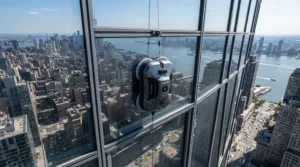
Window Cleaning Robot for Balcony Exterior Glass: What Changes Outdoors
A window cleaning robot for balcony exterior glass faces harsher conditions than one working indoors. Wind, dust, pollen and rain all matter, and the consequences of a slip are real.
Weather is the first filter. CHOICE’s lab review of the Ecovacs Winbot W1 Pro warns against using the robot outdoors in gale-force winds or rain, and against greasy or uneven surfaces. You can read more in its full W1 Pro review. Manuals for other robots echo the point: humid or rainy days also leave streaks.
Second, exterior glass often means frameless railings. Choose a robot with edge-leakage or coupler sensing, such as Hobot S7 Pro or Ecovacs Winbot W1 Pro, and stay close enough to intervene.
Third, power. Balconies rarely have outlets, which is why the station-battery Ecovacs Winbot W2 Omni line suits them best. A long extension cord on a balcony is both a trip hazard and a rope-management headache.
Finally, check the tether. Anchor the rope indoors, never to the balcony railing the robot is cleaning.
Automatic Window Cleaner for Tall Apartment Buildings: Safety, Wind and House Rules
An automatic window cleaner for tall apartment buildings raises questions that go beyond product specs. The higher you live, the more wind, and the more consequence if something falls.
Wind. Air pressure and gusts rise with height. Even a strongly adhered robot should stay home on blustery days. Plan exterior cleaning for calm mornings, not storm fronts.
The anti-fall rope. Treat it as mandatory, always. Several manufacturers say so outright, and the rope is cheap insurance against a falling object landing on a sidewalk or a neighbor’s balcony.
Building rules. Some leases, condo boards and co-op rules restrict exterior work or hanging equipment from balconies. I can’t give legal advice on that point, so check your lease or house rules before you buy, and ask management if you’re unsure.
People below. Where there’s no balcony beneath the window, manuals recommend marking a warning area on the ground so nobody walks under it.
Warranty and coverage. Some brands advertise optional or included damage protection for suction failures. Read the exclusions closely, because policies differ and are limited to specific scenarios.
In short, safety is a habit, not a feature. The right robot lowers risk, and the right routine does the rest.
Robot vs Traditional Alternatives: Cost and Maintenance Over Time
| Method | Safety on High Floors | Upfront Cost | Effort | Best For |
|---|---|---|---|---|
| Ecovacs Winbot W2 Omni | Rope + suction + sensors | $450-$600 | Low | Outlet-free balconies, regular cleaning |
| Mamibot W120-T | Rope + 20 min UPS | $200-$300 | Low | Light-duty interior glass |
| Squeegee and pole | Requires leaning out | Under $50 | High | Reachable windows |
| Professional cleaners | Done by trained crews | Per-visit fees | None | Occasional deep cleans |
Looking at the comparison above, the real trade-off is between your time and your money. Manual cleaning is cheap but demands effort and, on high floors, risk. A professional visit removes both but repeats its cost every time. A robot such as Ecovacs Winbot W2 Omni costs more upfront but pays back across dozens of cleans.
Here’s a simple way to think about it. If a pro visit would cost you $150 to $250 and you’d otherwise book four a year, a mid-range robot at $450 to $600 breaks even within the first year or two. Your numbers will vary, but the logic holds.
On the maintenance side, budget for replacement pads, cleaning solution and an occasional rope replacement. Models like Mamibot W120-T have inexpensive consumables, which keeps long-term cost low.
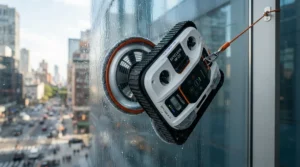
FAQ
❓ Can a cordless window cleaning robot for high-rise apartment use run without any outlet?
❓ How long does the backup battery keep a window cleaning robot stuck if power fails?
❓ Do I still need the anti-fall rope if my robot has strong suction?
❓ Will these robots work on frameless glass balcony railings?
❓ How much should I budget for a good window cleaning robot?
Conclusion: Which Cordless Window Cleaning Robot for High-Rise Apartment Living Should You Buy?
Here’s the short version. If you need a true cordless window cleaning robot for high-rise apartment glass with no outlet nearby, the Ecovacs Winbot W2 Omni, Ecovacs Winbot W2 Pro Omni and Ecovacs Winbot W2S Omni are the three real answers in this lineup. Pick the Ecovacs Winbot W2 Omni for value, the Ecovacs Winbot W2 Pro Omni for the best all-around package, and the Ecovacs Winbot W2S Omni when you want maximum suction margin.
If you have an outlet and mostly clean interior glass, the corded Hobot S7 Pro polishes well, while Hobot 2S, Mamibot W120-T and Ecovacs Winbot W1 Pro are sensible budget-friendly routes with clear limits on heavy dirt.
Above all, remember that no robot replaces a good habit. Anchor the rope, inspect it, watch the weather and check your building rules. The best result isn’t the shiniest glass, it’s a clean pane and a safe sidewalk.
Recommended for You
- [Add your blog post link 1]
- [Add your blog post link 2]
- [Add your blog post link 3]
Disclaimer: This article contains affiliate links. As an Amazon Associate, I earn from qualifying purchases. If you purchase products through these links, we may earn a small commission at no additional cost to you.
✨ Found this helpful? Share it with your friends! 💬🤗
