
In This Article
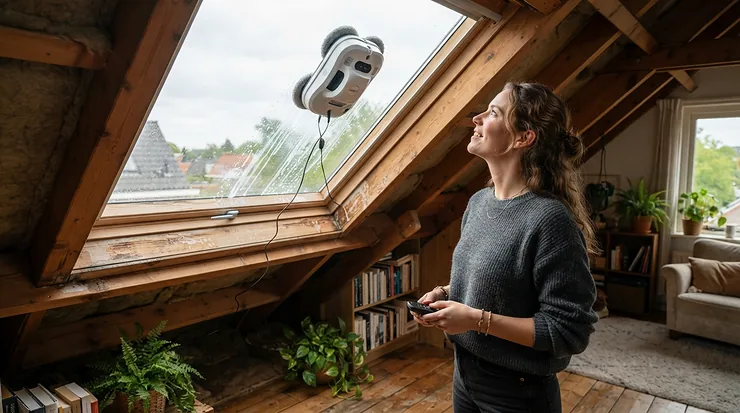
A window cleaning robot with safety rope for skylights is a suction-clinging, microfiber-wiping machine that crawls across glass on its own while a tied-off rope acts as the fail-safe. Combine strong vacuum suction, edge sensors, a backup battery and an anchored tether, and you can clean high glass without a ladder.
Skylights are lovely right up until you look up. 🌤️ Australia’s government Your Home guide notes that a skylight or roof window can admit more than three times the daylight of a vertical window of the same size. That same glass collects pollen, rain spots and bird droppings, and it sits exactly where a wobbly stepladder is a bad idea.
Robots promise to fix that. But the category is crowded with bold suction numbers and thin safety detail, so I dug through spec sheets, manuals and published reviews. I did not test any of these products myself, and nothing below pretends otherwise. What follows is analysis built on real specs and real review themes.
One honest caveat up front. Most window robots are engineered for vertical glass. Skylights are tilted or overhead, which is a harder job. The rope is not a nice-to-have here. It is the whole point. Keep that in mind as you read.
Quick Comparison Table: 7 Window Cleaning Robots With Safety Ropes
| Product | Suction (as published) | Power & Backup | Rope / Tether | Edge Handling | Price Range | Best For |
|---|---|---|---|---|---|---|
| FRUITEAM Automatic Window Cleaning Robot | 3,000 Pa | Corded, ~20-min battery | Rope included | Anti-fall sensors | Under $100 | Budget first-timers |
| Mamibot W120-T | 3,000 Pa | Corded, ~20-min UPS | 4.5 m rope | Gyro-guided paths | $200-$250 | Small, lightweight jobs |
| ECOVACS WINBOT W1 Pro | 2,800 Pa | Battery, ~30 min | Tether with suction pod | Optical edge sensing | $200-$300 | Spots with no outlet |
| HOBOT-2S | ~6-7 kgf lifting force | Corded, ~20-min UPS | 4.5 m, 150-200 kg rated | Edge-leakage sensors | $250-$350 | Streak control |
| HUTT A1 | 6,000 Pa | Corded, ~30-min backup | 145 kg rope | Laser edge detection | $250-$350 | Frameless glass |
| HOBOT S7 Pro | 4,800 Pa | Corded, ~20-min UPS | Rope included | ELB air-leak sensors | Mid-$400s | Large panes, polish |
| ECOVACS WINBOT W2 Pro Omni | 2,800 Pa (5,500 Pa emergency) | Battery ~110 min, plug-in option | Integrated cable system | Optocoupler edge sensor | $350-$450 | Premium, cordless |
Read the table sideways before reading it down. The HUTT A1 has the biggest published suction at 6,000 Pa, but the ECOVACS WINBOT W2 Pro Omni wins on independence from wall outlets. For a skylight that sits far from a socket, that matters more than raw grip. Budget buyers should note the FRUITEAM Automatic Window Cleaning Robot trades review depth and polish for price, while the HOBOT S7 Pro asks a mid-$400s premium for cleaner finishing.
💬 Just one click — help others make better buying decisions too!😊
Top 7 Window Cleaning Robots With Safety Rope for Skylights: Expert Analysis
1. FRUITEAM Automatic Window Cleaning Robot — cheapest way to test the idea
The big draw is the entry price. Listings advertise 3,000 Pa of suction, dual water spray, app and remote control, a safety rope and anti-fall sensors. A built-in battery is said to hold the robot on the glass for about 20 minutes if the power drops.
In practice, 3,000 Pa is a respectable grip on vertical glass. On tilted skylight glass, gravity pulls differently, so your safety margin is thinner. The spec sheet doesn’t say how that suction changes with tilt, so read the manual’s angle limits before you buy.
This model suits renters, one-off jobs and anyone curious whether robots are worth it. One 2026 round-up called it a budget pick backed by a large review pool. I couldn’t verify individual review text, so treat that sentiment as directional.
Pros:
- ✅ Lowest entry cost in this lineup
- ✅ Dual spray plus app and remote control
- ✅ Rope and backup battery included
Cons:
- ❌ Thin suction margin on tilted glass
- ❌ Review quality varies by seller
Price range: under $100. Value verdict: a low-risk experiment, as long as you tie the rope every single time.
2. Mamibot W120-T — lightest build for fussy ceiling reach
The standout is weight. The Mamibot W120-T weighs about 1.35 kg and is roughly 10 cm thick. That’s a real advantage when you are placing a robot on glass above your head.
Key specs include 3,000 Pa suction, a maximum vertical load of 7 kg and a 4.5 m safety rope. It also has a 20-minute UPS battery and a Z and N cleaning path. A gyroscope helps it return to its start point.
Here’s what that means. The 7 kg load rating shows the suction can hold more than the robot’s own weight, which is the margin you want. The short UPS window gives you minutes, not hours, to retrieve it after a power cut.
Buyer reviews are mixed. Some owners call it light and easy to use. Others report that the tracks clog with dust on dirty glass and cause slipping, that it struggles with triangular panes, and that it is best for lightly soiled windows.
Pros:
- ✅ Very light for overhead placement
- ✅ 4.5 m rope with 20-minute UPS
- ✅ Simple Z and N cleaning paths
Cons:
- ❌ Tracks slip on heavily dusty glass
- ❌ Poor fit for triangular panes
Price range: roughly $200-$250. Value verdict: good for routine upkeep, a poor match for neglected glass.
3. ECOVACS WINBOT W1 Pro — battery-powered, so no cord to chase
The headline feature is cordless operation. The ECOVACS WINBOT W1 Pro runs on a battery for around 30 minutes, with 2,800 Pa suction and an 8-level safety concept. Its maker says optical edge sensing adjusts the route in 0.02 seconds.
That matters for skylights. Ceiling-height glass is often far from an outlet, and a trailing power cord tugging at a robot overhead is nobody’s idea of fun. Battery power removes that problem, though 30 minutes of run time limits how much glass you cover per charge.
Its safety tether ends in a rubber suction pod meant to arrest a fall. That’s clever, but it still needs a fixed point behind it. One reviewer liked it for around 80% of the windows in their home. They also warned that it isn’t suited to small windows and that you need something solid to tie the rope to. Another found results a bit smeary, and weak against bird droppings.
Pros:
- ✅ Cordless, so no outlet needed
- ✅ Fast optical edge sensing
- ✅ Tether with suction pod included
Cons:
- ❌ About 30 minutes of run time
- ❌ Can leave streaks, struggles with droppings
Price range: roughly $200-$300. Value verdict: smart when the nearest socket is the problem.
4. HOBOT-2S — best for streak-conscious owners
The standout is dual ultrasonic spray. The HOBOT-2S mists the pad on both sides, which helps avoid the dry-drag streaks cheaper robots leave behind.
Specs: square body of about 240 x 240 x 86 mm, around 1.3 kg and a 4.5 m rope rated at up to 200 kg (some third-party sheets list 150 kgf). It also carries a roughly 20-minute emergency battery. Hobot publishes suction as lifting force of about 6-7 kg, not Pa, so don’t compare it directly with the Pa numbers elsewhere.
The square shape reaches corners that round robots miss, which suits rectangular skylight panes. Its edge-leakage sensors and auto edge detection tell it when it has run out of glass. It is an older platform, released in 2021, so you’re paying for a proven design rather than the newest tech.
I couldn’t find enough verified review text to summarize honestly. That’s a limit of my research, not a verdict.
Pros:
- ✅ Dual ultrasonic spray for fewer streaks
- ✅ Square body reaches corners
- ✅ 4.5 m rope with strong rating
Cons:
- ❌ Suction published in kgf, hard to compare
- ❌ Older 2021 platform
Price range: roughly $250-$350. Value verdict: fair if finish quality matters more than headline numbers.
5. HUTT A1 — laser-guided for frameless glass
What stands out is the laser sensor system. The HUTT A1 uses laser edge detection, with a total of 13 sensors, to map window borders instead of relying on pressure readings alone.
It lists 6,000 Pa suction that adjusts automatically, four spray nozzles, a 150 ml tank, a 145 kg rope and a 650 mAh battery for about 30 minutes of backup. In plain terms, the generous backup gives you a longer rescue window than most rivals, and the big tank means fewer refills on large panes.
Frameless glass is where laser sensing earns its keep, because there is no frame to bump into. Round-ups call it a top-rated pick. A retailer listing flags the downsides: it’s heavier than compact models at around 1.9 kg, corded only, and overkill for small windows.
Pros:
- ✅ Laser edge detection on frameless glass
- ✅ Strong 6,000 Pa suction
- ✅ 30-minute backup, 145 kg rope
Cons:
- ❌ Heavier at roughly 1.9 kg
- ❌ Corded only, oversized for small panes
Price range: roughly $250-$350. Value verdict: top-tier safety per dollar for large or frameless glass.
6. HOBOT S7 Pro — best polish on big panes
The standout is dual reciprocating pads. The HOBOT S7 Pro scrubs at roughly 600 strokes per minute with 4,800 Pa of suction and two 80 ml tanks. Its total charge cable runs about 6.4 m.
Its ELB sensors respond to air leaks and frame bumps. That matters because a robot overhead that loses its seal needs to react immediately, not after a lap of glass.
Here’s what TechRadar’s review says. It navigates accurately and misses no spots, and it’s excellent for maintenance cleans. It can smear dirtier windows, isn’t especially fast, and the voice prompts are annoying. A separate buyer review noted a dead zone of about 1 cm at the sides and 2 cm in the corners, and said it doesn’t clean on inclined surfaces. That last point is critical for skylights, so confirm tilt limits with Hobot.
Pros:
- ✅ Reciprocating pads polish well
- ✅ Accurate navigation on large panes
- ✅ ELB sensors react to seal loss
Cons:
- ❌ Reported weakness on inclined glass
- ❌ Slow, with intrusive voice prompts
Price range: mid-$400s. Value verdict: premium finishing for vertical skylight walls, not a proven overhead solution.
7. ECOVACS WINBOT W2 Pro Omni — premium cordless with a portable station
The headline is the portable station. The ECOVACS WINBOT W2 Pro Omni carries a roughly 110-minute battery, plus a plug-in mode. The station weighs about 5.2 kg and is backed by 800 N of suction force.
Suction runs at 2,800 Pa in normal mode and rises to 5,500 Pa in emergency mode. It uses a 12-stage protection system with an optocoupler edge sensor and a 30-minute battery backup.
That layering is what you pay for. Normal suction keeps wear low, while emergency mode adds grip if something goes wrong. Reviewers rated results from satisfactory to excellent on bifold panels and advise rinsing the pads often. One review suggested the cable and added suction reduce the need for a separate rope. For anything overhead, I’d still treat a rope as mandatory.
Pros:
- ✅ Long battery for several panes
- ✅ Emergency suction boost
- ✅ 12-stage protection system
Cons:
- ❌ Highest price in this group
- ❌ Bulkier station to store
Price range: roughly $350-$450. Value verdict: worth it for tall, remote or multi-pane skylights.
✨ Don’t Miss These Exclusive Deals!
🔍 Take your skylight care to the next level with these carefully selected robots. Click on any highlighted item to check current pricing and availability. These tools will help you get clearer, brighter glass your whole household will notice!
How to Choose a Window Cleaning Robot With Safety Rope for Skylights
Start with a short checklist, then match it to your glass.
- Check the tilt rating first. Look for the manufacturer’s stated angle range. One listing recommends its robot for skylights at angles of 30° or more and not for horizontal surfaces. Another source says inclined use is typically 60°-120°. If the manual is silent, assume the robot isn’t rated for overhead glass.
- Confirm the rope length and rating. Rope lengths of 4-5 m are typical, with ratings from about 145 kg to over 200 kg. The rope has to reach your anchor with slack to spare.
- Match power to your location. Corded models need an outlet and cable length. Battery models like the ECOVACS WINBOT W1 Pro and ECOVACS WINBOT W2 Pro Omni avoid that, but limit run time.
- Look for a backup battery. Twenty to thirty minutes is common. It’s a rescue window, not cleaning time.
- Prefer real edge detection. Frameless or tight skylights demand sensors, not luck.
- Compare suction fairly. Pa, kgf and N are different units. Don’t compare them directly.
- Weigh the robot. Lighter units like the Mamibot W120-T are easier to place overhead.
Which?’s expert guide makes a point worth repeating. If the suction fails, the device might fall and damage the glass unless it’s secured with a tether inside the house. Choose for the failure case, not the demo.
Suction Power: What the Pa Number Actually Buys You
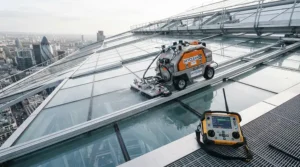
Suction power is the force holding the robot to the glass. It’s the headline spec and the most misunderstood one. A higher Pa number doesn’t automatically mean better cleaning, and it doesn’t alone guarantee safety.
Think of it as seal quality, not strength. The fan has to keep a pressure difference across the pad. Any leak at a frame edge, a gasket or a rough patch drops that pressure. Some systems monitor and compensate. The ECOVACS WINBOT W2 Pro Omni raises suction from 2,800 Pa to 5,500 Pa in emergency mode, and its maker says it detects air leaks in a fraction of a second.
Why not run at maximum all the time? Higher suction means more drag, more wear on pads and often more noise. Budget models at 3,000 Pa, like the FRUITEAM Automatic Window Cleaning Robot and Mamibot W120-T, work on clean vertical glass. The HUTT A1 at 6,000 Pa gives more headroom on tilted or slightly textured panes.
Remember, though, that no published suction figure was measured on your skylight. Treat the number as a rough guide and let the rope do the safety work.
Safety Rope Anchor: Where and How to Tie Off
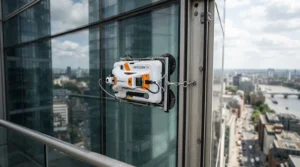
The safety rope anchor is the single most important point in the entire setup. A 200 kg rope tied to a curtain rod is a 2 kg rope in practice. Manuals for these robots all say the same thing: tie the rope to a fixed indoor object before running.
A simple setup routine:
- Pick a structural anchor. Heavy furniture bolted down, a solid window frame member or a purpose-fitted eye bolt. Avoid blinds, curtain rails and anything on casters.
- Check the rope and knot. Look for fraying, and test that the buckle and knot are secure before every run.
- Fully charge the backup battery. The green light should be on before you start.
- Keep slack short. Enough for travel, not enough for a long swing. A fall that lets the robot hit the glass frame can still crack panes.
- Clear the area below. Move people, pets and breakables out from under the glass.
- Place the robot, then let go. Hold it flat against the glass, switch it on, wait for suction to engage and listen for the seal.
A good anchor beats an expensive robot every time. If you can’t find a safe anchor near the skylight, that’s a sign this isn’t a robot job.
Skylight Cleaning Robot With Suction Safety Tether: How the Layers Work
A skylight cleaning robot with suction safety tether relies on layered protection, not a single trick. Understanding the layers helps you judge which failures each one covers.
Layer one is suction. It holds the robot on the glass during normal use.
Layer two is the sensing system. Pressure and air-leak sensors stop the robot before it drives off an edge or loses its seal.
Layer three is backup power. When mains power drops, a small battery keeps the fan running. Typical windows are 20-30 minutes, and the robot usually sounds an alarm. It buys time to retrieve the unit. It doesn’t buy time to keep cleaning.
Layer four is the rope. If everything else fails, it stops a fall. The ECOVACS WINBOT W1 Pro adds a suction pod on its tether, intended to arrest a fall with a highly elastic rubber cord. Pull the rope gently at a shallow angle close to the glass, as Hobot’s manuals advise, so the robot doesn’t swing down.
The honest takeaway is that the layers aren’t equal. Three of them are electronic and can fail. The rope is the only mechanical one, which is why it deserves the most care.
Edge Detection: Why It Matters on Frameless Skylights
Edge detection is how a robot knows where the glass ends. On a framed window, a bump sensor can do the job. On frameless glass, the robot has to sense the drop-off before its seal breaks.
Systems differ. The HUTT A1 uses laser sensors. The ECOVACS WINBOT W1 Pro uses an optical coupler sensor that reroutes in 0.02 seconds. The HOBOT S7 Pro relies on ELB sensors that also detect air leaks between panes. The HOBOT-2S uses edge-leakage sensors plus auto edge detection.
Here’s the practical meaning. Laser and optical systems work best on clean, flat glass. Dirt, droplets or a pad covering a sensor can confuse them. Hobot’s manual warns that its laser sensors must not be covered by the cleaning cloth.
Edge handling also affects what’s left uncleaned. One owner of the HOBOT S7 Pro reported a dead strip of about 1 cm at the sides. Corners are harder. If your skylight has a thick frame, a robot that can’t reach the edges will leave a rim of grime. Accept a manual wipe for the last centimeter.
Glass Cleaning Robot for Hard-to-Reach Ceiling Windows: What’s Realistic
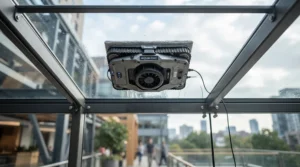
This is where honesty matters most. A glass cleaning robot for hard-to-reach ceiling windows faces a harder physics problem than any vertical pane. Gravity pulls it away from the glass, so suction has to do more, and a fall means a drop onto whatever is below.
What do the sources say? One retailer listing recommends a 3,000 Pa model for skylights at angles of 30° or more and warns against horizontal surfaces. A buyer review of the HOBOT S7 Pro says it doesn’t clean inclined surfaces. A Mamibot listing describes its robot for both vertical and horizontal use, but that’s a marketing claim, not independent proof.
The sensible reading: steeply pitched or near-vertical skylights and glass walls are plausible. Truly flat, overhead ceiling glass is where I’d be cautious, and I’d confirm the model’s tilt rating in writing.
Safety applies to you, too. OSHA’s interpretation letter treats a skylight as a hatchway, an opening through which persons may fall. Never stand on or lean over roof-side glass to place a robot. Clean from the inside, from a stable platform, with the rope anchored.
Window Cleaning Robot vs Alternatives: Ladders, Poles and Pros
| Option | Reach | Safety Risk | Ongoing Cost | Best For |
|---|---|---|---|---|
| HUTT A1 or similar robot | Glass within cord or battery range | Low with anchored rope | Pads and solution | Frequent cleaning |
| Extension pole and squeegee | 3-5 m | Low | Low | Low glass, quick jobs |
| Ladder and cloth | Variable | High | Low | Avoid for skylights |
| Professional service | Any | Handled by pros | Recurring fees | Exterior roof glass |
A robot like the HUTT A1 wins on safety and repeatability for interior glass, but it doesn’t beat a professional on exterior roof panes you can’t reach. The pole is cheaper and fine for low glass. The ladder loses everywhere except upfront cost. For most households with a few skylights, a robot plus an occasional pro visit is the practical blend.
Real-World Scenarios: Which Robot Fits Which Home
Scenario 1: The apartment renter with one stairwell skylight. Budget is tight, glass is clean and pitched steeply. The FRUITEAM Automatic Window Cleaning Robot or Mamibot W120-T covers monthly upkeep. Anchor to a fixed fitting, check the tilt rating and call it done.
Scenario 2: The family with a long glazed extension. Six panes, no outlet nearby and a pitched roof. The ECOVACS WINBOT W2 Pro Omni earns its price, because 110 minutes of battery covers several panes without cord hassle. If you want to start cheaper, the ECOVACS WINBOT W1 Pro handles one or two panes per charge.
Scenario 3: The owner of frameless glass walls and a clerestory. Edges are the problem. The HUTT A1 with laser sensing or the HOBOT S7 Pro with ELB sensors suit this best. Expect to hand-wipe the rim.
Scenario 4: The streak-hater with a mostly vertical conservatory. Finish quality dominates. The HOBOT-2S with ultrasonic spray, or the HOBOT S7 Pro with reciprocating pads, gives the most uniform result.
Match your glass, your outlet situation and your tolerance for risk, and the right model mostly picks itself.
Problem → Solution Guide: Common Skylight Robot Headaches
Problem: The robot slips or drifts. Dust on the glass or on the tracks is the usual cause. Pre-wipe heavy dirt, clean the tracks and make sure the pad is seated without air gaps. Buyers of the Mamibot W120-T reported track slip on dusty windows.
Problem: Streaks. Overloaded pads, wrong solution or too little spray. Swap to a fresh pad, use the recommended low-foam cleaner and avoid running in direct sun. The HOBOT-2S and HOBOT S7 Pro use ultrasonic spray to reduce this.
Problem: The robot won’t start or loses suction. Check for a dirty seal, a damaged pad or a leak at a frame. Rain-wet glass can also interfere with suction and sensors, so don’t run it in the rain.
Problem: It stops short of the edge. Normal. Plan a manual pass for the last centimeter.
Problem: A power cut mid-clean. Don’t panic. Backup batteries run 20-30 minutes. Go to the rope, pull it gently at a shallow angle and bring the robot down. Practice the motion before you need it.
Common Mistakes When Buying a Window Cleaning Robot for Skylights
Mistake one: buying on suction alone. A bigger number doesn’t prove the robot works on tilted glass. Check the angle rating and the sensor system.
Mistake two: skipping the anchor. Many owners treat the rope as an accessory. It’s the safety system.
Mistake three: ignoring cord length. A short cord near a high skylight forces awkward extension setups that can tug the robot off the glass.
Mistake four: expecting perfect edges. Every robot leaves a dead zone. Budget a quick manual wipe.
Mistake five: using it on dirty glass. Pre-clean heavy grime. Robots are for maintenance, and TechRadar’s reviewer described the HOBOT S7 Pro the same way.
Mistake six: buying on a single review. Review pools vary enormously by seller. Cross-check specs from the maker’s own manual, especially tilt and rope ratings.
Long-Term Cost & Maintenance: Is It Worth the Money?
| Tier | Price Range | Examples | Value Verdict |
|---|---|---|---|
| Budget | Under $100 | FRUITEAM Automatic Window Cleaning Robot | Low-risk trial |
| Mid-range | $200-$350 | Mamibot W120-T, ECOVACS WINBOT W1 Pro, HOBOT-2S, HUTT A1 | Best value for most homes |
| Premium | $350-$450+ | HOBOT S7 Pro, ECOVACS WINBOT W2 Pro Omni | Worth it for large or remote glass |
The mid-tier is the sweet spot because it adds backup batteries, stronger ropes and better sensors without the premium price. The premium tier pays off when glass is remote, large or frameless. Budget models make sense only if you accept thinner margins.
Running costs are modest. Expect replacement pads, cleaning solution and occasional rope or seal replacement. Wash pads after every use. Inspect the rope for fraying before every run, and replace it at the first sign of wear. A rope costs far less than a cracked skylight.
FAQ
❓ How much does a window cleaning robot with safety rope for skylights cost?
❓ Which robot works best when there's no power outlet near the skylight?
❓ Do I need to buy a separate safety rope?
❓ How often should I replace the cleaning pads?
❓ Can I run the robot when the glass is wet?
Conclusion
Here’s the short version. A window cleaning robot with safety rope for skylights can turn a risky ladder chore into a ten-minute, feet-on-the-floor task. But only if you pick the right machine and respect the rope.
For most households, the HUTT A1 is the strongest all-round safety package, with 6,000 Pa suction, laser edge detection and a 30-minute backup. If outlets are the problem, the ECOVACS WINBOT W2 Pro Omni is the premium cordless answer, and the ECOVACS WINBOT W1 Pro is the cheaper battery option. Streak-sensitive owners should look at the HOBOT-2S or HOBOT S7 Pro, and first-timers can start with the FRUITEAM Automatic Window Cleaning Robot or Mamibot W120-T.
Before you buy, do three things. Confirm the model’s tilt rating for your glass. Identify a solid anchor point. Plan for a manual wipe at the edges.
✨ Ready to leave the ladder in the garage? 🔍 Click on any highlighted product above to check current pricing and availability, then pick the robot that fits your glass. Your skylights, and your knees, will thank you! 🌤️
Recommended for You
- [Add your blog post link 1]
- [Add your blog post link 2]
- [Add your blog post link 3]
Disclaimer: This article contains affiliate links. As an Amazon Associate, I earn from qualifying purchases. If you purchase products through these links, we may earn a small commission at no additional cost to you.
✨ Found this helpful? Share it with your friends! 💬🤗
